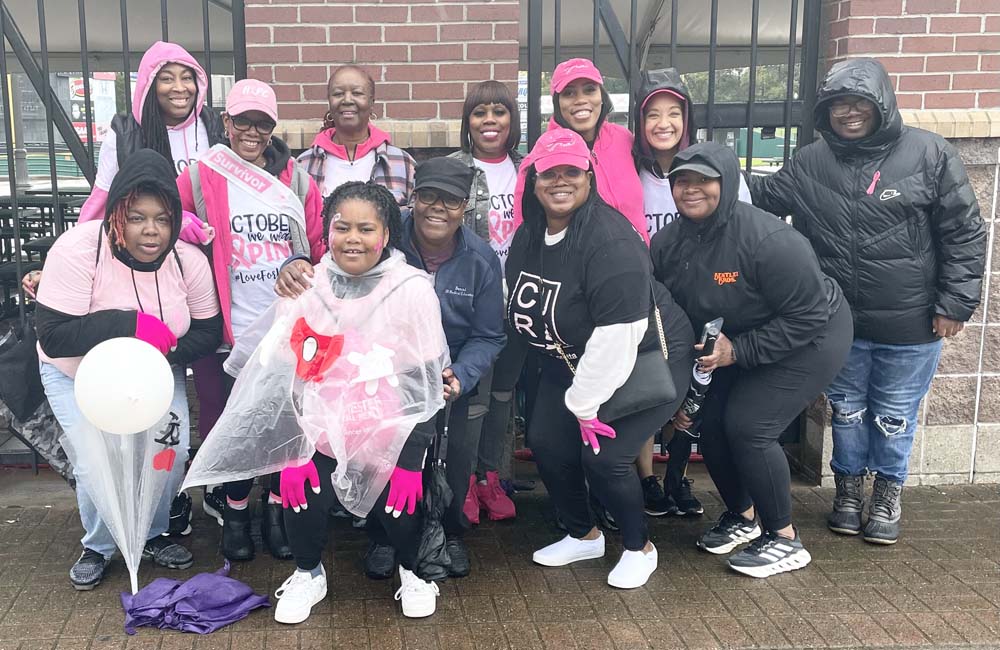
Loretta’s Path Through Breast Cancer and Reconstruction
For years, Loretta Cottrell had helped hundreds of patients wake up from surgery in the recovery rooms at Highland Hospital. She knew the rhythms of healing, the sounds of monitors, the relief in patients’ eyes when they realized their surgery was over. What she hadn’t expected was to find herself on the other side of those bed rails, facing a marathon 9.5-hour surgery and intensive recovery that would challenge everything she thought she knew about being a patient.
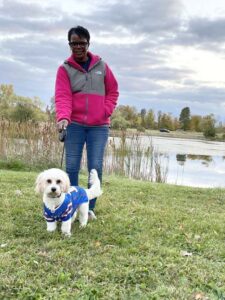
At 59, Loretta had built her life around caring for others. As a patient care technician, she spent her days monitoring vital signs, applying ice packs and helping post-operative patients take their first tentative steps. She’d been married for 36 wonderful years, raised two children who were now building their own lives, and found joy in family gatherings and trips to Caribbean islands with her family and friends. Life had a comfortable rhythm, punctuated by the wagging tail of Rocco, her cockapoo-bichon-beagle mix, greeting her after each shift.
The Discovery That Changed Everything
Loretta had always been diligent about her health. With dense breast tissue requiring extra vigilance, she’d maintained a routine of mammograms and ultrasounds every three to six months for the last five years. Monthly self-exams were as routine as brushing her teeth. So when her fingers found a pea-sized lump during one of these exams, she knew exactly what to do.
“I called the breast center immediately,” Loretta recalls. “I was already scheduled for a mammogram three days later, but they knew to be ready for me.” The medical team moved swiftly, ordering an ultrasound, mammogram and biopsy. When the results revealed three lumps, all in her right breast, Loretta’s professional knowledge became personal reality.
January 17, 2022, is etched in her memory. She had just arrived home from work when the phone rang. “The doctor asked if I was sitting down and if anyone was with me,” she remembers. “That’s when you know. That’s when your whole world shifts.”
The diagnosis: breast cancer. In that moment, Loretta transformed from caregiver to patient, from the one who provides comfort to the one who desperately needed it. She had the tremendous love and support of her family, but the diagnosis still shook her to her core.
“I was terrified, wondering if I was going to die,” she admits, her voice still carrying traces of that initial shock. “It was the worst day of my life. You see it happen to so many people in my line of work, but you never truly believe it’s going to happen to you. Even when you’re vigilant, even when you do everything right, that phone call still feels impossible. Unreal. But there it was, my new reality.”
A Decision Born From Experience
While many women diagnosed with breast cancer agonize over treatment options, Loretta’s decision came with unusual clarity. Years of watching breast cancer patients return for additional mastectomy surgeries had prepared her for this moment in ways she never anticipated.
“I’d seen so many women come back,” she explains. “They’d had partial or unilateral mastectomies, thinking they’d beaten it, only to return when cancer appeared in the other breast tissue. Some returned multiple times. Watching their disappointment and their exhaustion from repeated surgeries, I knew that if I ever faced this diagnosis, I would choose differently.”
Even though all three lumps were confined to her right breast, Loretta opted for a bilateral mastectomy to remove both of her breasts. It wasn’t fear driving her decision; it was the accumulated wisdom of countless hours in recovery rooms, holding the hands of women who wished they’d made a different choice the first time.
Her cousin had been diagnosed with breast cancer just a year earlier, adding a genetic component to her concerns. But it was her professional experience that solidified her resolve. “Some might call it aggressive,” she says. “I called it smart.”
Choosing the Right Surgical Team
Working at Highland Hospital had given Loretta a unique vantage point. She’d observed numerous surgeons in action, witnessed their bedside manner and seen how they interacted with patients when they thought no one was watching. When her genetic counselor recommended Dr. Rachel Farkas for her mastectomy and Dr. Stephen Vega for reconstruction, Loretta already knew their reputation.
“I’d seen how they treated their patients,” she shares. “There was something different about them. They had this genuine warmth, this way of making each patient feel like they mattered. Not all surgeons have that.”
Loretta’s first consultation with Dr. Farkas exceeded even her elevated expectations. “She spent almost two hours with me,” she marvels. “Two hours! She answered every question, explained every option, and never once made me feel rushed. She had this wonderful energy, like meeting an old friend who happened to be brilliant at breast cancer surgery.”
Meeting Dr. Vega confirmed her choice. “Here were these two surgeons who worked together like family,” she observes. “No ego battles, no competition. Just two professionals focused on giving me the best possible outcome.”
Choosing DIEP Flap Breast Reconstruction
The decision to undergo DIEP flap reconstruction came after careful consideration. Unlike older techniques that sacrifice abdominal muscle, this advanced microsurgical procedure would use only skin, fat and blood vessels from her lower abdomen to reconstruct her breasts. As someone who valued maintaining her core strength and active lifestyle, the muscle-sparing approach appealed to Loretta’s practical nature.
Dr. Vega’s expertise in microsurgery made him the ideal surgeon for this complex procedure. DIEP flap reconstruction requires reconnecting tiny blood vessels under a microscope, work so precise that a surgeon’s hand must remain steady for hours while manipulating vessels thinner than a strand of spaghetti. In the Rochester area, few surgeons perform this advanced technique. Dr. Vega had dedicated years to mastering the meticulous skills required, and Loretta felt confident placing herself in his hands.
Dr. Vega’s honesty about the reconstruction process resonated with her practical nature. “He was upfront from the beginning,” she explains. “He said we might need revisions to get everything just right, that it’s not unusual with complex reconstructions. I appreciated that honesty. No false promises, just confidence backed by real skill.”
When Everything Became Complicated
March 2022 arrived with equal measures of hope and anxiety. Loretta had prepared for surgery the way she’d advised countless patients to prepare: mentally rehearsing the process, arranging family support, and setting realistic expectations for recovery. What she hadn’t anticipated was how a previous surgery would complicate her procedure.
Years earlier, Loretta had undergone a myomectomy to remove uterine fibroids. The resulting scar tissue in her abdomen turned what should have been a complex but routine breast reconstruction procedure into a surgical marathon. As Dr. Vega carefully navigated through layers of adhesions to harvest the tissue and blood vessels needed for reconstruction, the hours ticked by. What was typically a six- to eight-hour procedure stretched to over nine hours.
The extended surgery had taken its toll. Loretta experienced complications that required comprehensive monitoring and additional interventions. Instead of the typical two- to three-day hospital stay, she found herself in the ICU for five days. For someone accustomed to being on the giving end of medical care, the role reversal was profound. The complications and intensive recovery left her questioning whether she had made the right decision in choosing breast reconstruction.
Making matters more challenging, COVID restrictions meant Loretta could have only two designated visitors for her entire five-day stay. Her husband and son provided steadfast support, but the absence of her mother, sister and daughter, with whom she typically spoke daily, added an unexpected emotional burden. “Going through something this big without them physically there with me was harder than I expected,” she admits. “But when I finally got home, they came immediately and stayed for hours. I joke that I couldn’t get rid of them, but honestly, I didn’t want to.”
While family support at the hospital was limited by circumstances, Dr. Vega’s attention never wavered. “Every day, Dr. Vega personally came to check on me,” Loretta remembers. “Right as I was waking up from surgery, I could hear his voice as he was checking on the flaps. Later, he explained how the scar tissue had made everything more challenging, but he never made me feel like I was a burden or a difficult case. He was just so matter-of-fact about it, like ‘We handled it, you’re doing great, here’s what happens next.’”
Another Setback and Unexpected Kindness
Recovery rarely follows a straight line, a truth Loretta knew professionally but learned personally when, a month after surgery, a familiar sharp pain shot through her chest. Having experienced a blood clot after her C-section years earlier, she recognized the sensation immediately.
“I called right away and ended up in the emergency department,” she recounts. The diagnosis confirmed her suspicions: a blood clot requiring immediate treatment. Fortunately, she was able to return home within 24 hours after an overnight hospital stay on blood thinners.
What happened during that hospital stay still brings wonder to her voice. “Dr. Farkas was doing surgery at Unity Hospital that day. Somehow, she heard I was in the ED there and came to find me. She checked on me to make sure I was okay and took me for a walk to help my circulation. I kept thinking, ‘Surgeons don’t do this!’ In all my years in healthcare, I’d never seen that level of personal attention.”
This moment crystallized what Loretta had suspected: she’d found medical professionals who saw her as more than a surgical case. She was a person worth walking with, worth checking on, worth going above and beyond for.
From Doubt to Healing & Wholeness
Loretta’s recovery stretched longer than anticipated. For someone who describes herself as a “go-getter,” the forced inactivity challenged her in unexpected ways. “I’m not someone who sits still easily,” she admits. “But my body needed time, more time than I wanted to give it.”
In those early days, Loretta also found herself wrestling with unexpected emotions. “With the swelling and the scars, my breasts looked nothing like I’d hoped,” she confesses. “When the complications happened and when I realized I’d need more surgeries to revise my breasts, I kept thinking, ‘Why did I do this to myself?’ I blamed myself for putting my body through this, even though logically I knew it wasn’t my fault.”
But Dr. Vega’s steady reassurance became her lifeline during these dark moments. “He never wavered,” she recalls. “He’d look at me and say, ‘I’ll get you where you want to be. Trust the process. These results are temporary.’ He was so confident, so sure, that I started to believe him.”
Two additional surgeries followed: one in December 2022 and another in June 2023. These breast revision procedures used fat grafting, a technique where Dr. Vega carefully removed small amounts of fat from her abdomen through liposuction and then precisely injected it into her breasts to create better symmetry and shape.
Compared to the initial surgery, these procedures were far less intensive. “Those recoveries were a walk in the park compared to the first one,” Loretta laughs. “And each time, my results got better and better. Looking back now, I’m so glad I did it. I would absolutely do it all again, complications and all.”
The Final Touch
The physical reminders of her journey have evolved too. In June 2025, she underwent nipple tattooing at Dr. Vega’s office, the final step in her reconstruction. “I don’t have any other tattoos, so I was a little nervous,” she admits. “But it barely hurt at all. And now when I look in the mirror, I see myself. Not cancer, not scars, not what I’ve been through. Just me.”
Discovering Strength in Vulnerability
Throughout her journey, Loretta found herself drawing on reserves of strength she didn’t know she possessed. The woman who had comforted countless patients now needed comforting. The one who encouraged others to stay positive had to find her own reasons for hope.
“My friends and family kept commenting on how positive I stayed,” she reflects. “But what was the alternative? I wasn’t going to lie down and die. I had too much to live for, too many people who needed me.”
Her faith became an anchor during the most challenging moments. “Never let your worry be greater than your faith,” she says, words that became her mantra through multiple surgeries and setbacks. “Faith doesn’t mean you’re not scared. It means you keep going despite the fear.”
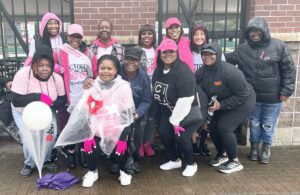
The support from Dr. Vega’s entire team reinforced her determination. From the front desk staff who greeted her by name to the nurse practitioners who managed her follow-up care, Loretta felt held by a network of professionals who genuinely cared about her outcome.
“I sent them thank you notes and cookies,” she shares. “How could I not? Every single person in that office treated me like I mattered. That’s rare in healthcare today, and I would know.”
Full Circle: Living Proof of Strength
By summer 2025, Dr. Vega declared Loretta officially “graduated” from her breast reconstruction journey. The woman who had walked into his office three years earlier, armed with professional knowledge but personal fear, had transformed in ways that went beyond physical healing.
“When people ask how I am now, I tell them ‘I beat breast cancer, I’m great!'” she declares with pride. “This journey made me stronger than I already was. And I was pretty strong to begin with.”
Loretta has returned to the work she loves, bringing a new dimension of empathy to her role. When she helps patients wake up from surgery, she understands their vulnerability in a way she couldn’t before. When she sees fear in their eyes, she can offer reassurance born from personal experience.
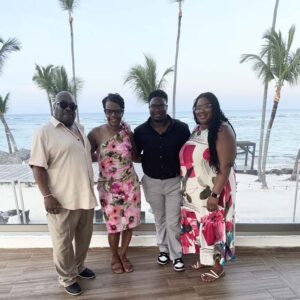
These days, Loretta’s life has returned to its familiar rhythms, enriched by profound gratitude. She still works at Highland Hospital, still travels to warm beaches with her friends and family, and still takes evening walks with her husband, son and Rocco. Her daughter visits from Buffalo, and family gatherings remain the cornerstone of her joy.
But there’s a depth to her happiness now, a recognition of life’s preciousness that comes only through surviving a significant threat. She finds herself savoring ordinary moments that once passed unnoticed. And when she performs her monthly self-exams, she does so with gratitude for the early detection that saved her life.
Words of Wisdom
Loretta’s endorsement of Dr. Farkas and Dr. Vega comes without hesitation. “They’re the dynamic duo,” she says with evident affection. “They’re on the same page with the same caring ethics. That’s amazing in healthcare. They’ll answer every question, address every concern, and genuinely be there for you.”
For women facing similar decisions, Loretta offers hard-won wisdom tempered with compassion. “Be prepared that you might need more than one surgery,” she advises. “Not to scare you, but to prepare you. When you know it’s a possibility, you’re not devastated if it happens. And if you become angry with yourself, like I was, be gentle. Those feelings are normal. They pass.”
“Would I do it all again, knowing everything I know now?” she asks rhetorically. “Absolutely. Every surgery, every setback, every challenging day of recovery. Because I’m here. I’m healthy. I’m whole. And I’m living proof that with the right team, you can get through anything.”
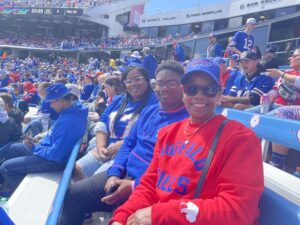
Her message to others facing this journey is quintessentially Loretta: practical, honest and infused with hope. “Fight hard and never give up,” she says simply. “You’re stronger than you think. And with surgeons like Dr. Vega and Dr. Farkas in your corner, you’re never fighting alone.”
In the end, the woman who’d spent years caring for others discovered that accepting help isn’t weakness — it’s wisdom. And sometimes, the best caregivers make the most determined patients, turning their time on the other side of the bed rails into something powerful: a deeper well of understanding that only comes from having walked the path yourself.



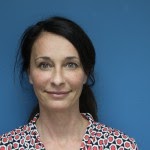 Hello, my name is Melanie Morreale. I attended art school in 1992, majoring in graphic art. Some of the things I loved were color theory, photography and illustration. I started my tattooing apprenticeship while in school and began working full time as an artistic tattoo artist right after college.