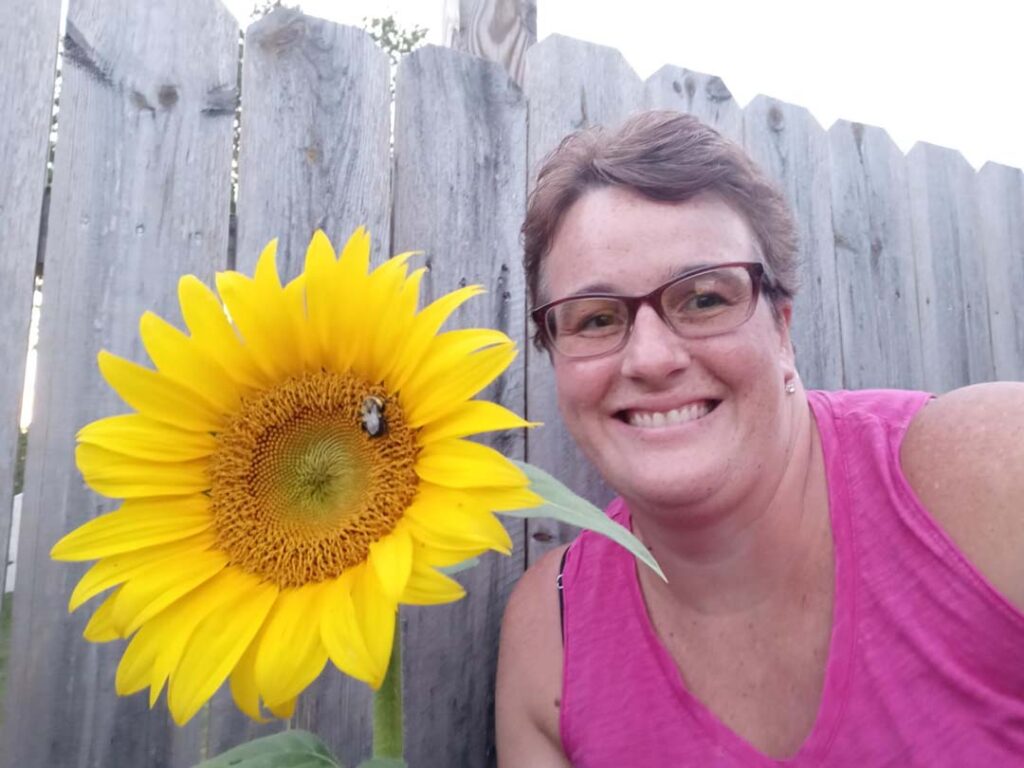
Sally sat in her car by Canandaigua Lake, tears streaming down her face. At 37, she’d learned she carried a genetic mutation: a ticking time bomb in her DNA that, combined with her family history, gave her up to a 90% chance of developing breast cancer. The PALB2 mutation that had already wreaked havoc on her family tree was silently lurking in her genes, too.
A Family Marked by Cancer
The road to Sally’s lakeside breakdown had begun years earlier, as she watched cancer systematically attack the women in her family. Her mother was diagnosed with breast cancer nearly 20 years ago and underwent a mastectomy and chemotherapy. Two of her mother’s sisters had faced the same battle. Then in 2020, when her oldest sister noticed one breast sinking inward, the diagnosis came again: breast cancer.
It was during her sister’s genetic testing that the family learned about the PALB2 mutation. As one of six sisters in a family of seven children, Sally wasn’t the only one watching and wondering. The genetic revelation meant all the sisters now faced the possibility of carrying this mutation, turning one sister’s diagnosis into a family-wide reckoning.
Having lost her job during COVID, Sally became her sister’s primary caregiver. “I got to see firsthand what cancer and the treatment process did to her,” Sally says. “My heart broke watching her struggle through the pain and exhaustion, seeing this strong, independent woman suddenly need so much help. It opened my eyes to what could be waiting for me.”
The Weight of Knowing
The decision to get tested wasn’t easy. “There’s almost a bliss in not knowing,” Sally reflects. “Once you know, you’ve got difficult decisions to make. But I realized I needed to value myself enough to find out.”
What followed was a two-year odyssey that would test Sally’s resilience in ways she never imagined. Having the PALB2 gene mutation meant she had to alternate between getting MRIs and mammograms every three months. Several suspicious masses appeared on one side, leading to multiple biopsies.
“The biopsies were the most painful thing,” she remembers. “My whole breast would hurt, turn purple and stay bruised for weeks. And the results were always concerning but never conclusive. The doctors would say things like ‘tinges of cancer’ or ‘it looks suspicious, but it’s not cancerous.’ It was agonizing.”
Finding Purpose in Service
Despite the heavy cloud of genetic risk hanging over her family, Sally found solace in creating beauty with her hands. An avid crafter, she spent evenings crocheting and knitting hats and scarves for the homeless and sewing dresses for girls in Africa through her church’s missionary program. “There’s something deeply fulfilling about creating something that will make a little girl halfway around the world feel beautiful and special,” she says.
These acts of service had been woven into the fabric of Sally’s life for years. During the uncertain months of testing and waiting, this sense of purpose became an anchor, reminding her that even in her darkest moments, she could still bring light to others.
The Loneliness of an Invisible Battle
Perhaps the most isolating aspect of Sally’s journey was how few people understood her situation. Despite the suspicious masses and frightening biopsy results, Sally wasn’t quite a cancer patient but was living with the constant threat of becoming one.
“Having the gene mutation is almost as serious as having cancer, but people don’t respond the same way,” she explains. “When someone says they have cancer, there’s immediate support and understanding. When you say you have a genetic mutation that will cause cancer, people look confused. I felt like I was fighting this huge battle that no one could see or understand.”
Decisions of Body and Identity
Once Sally knew she had such a high risk of developing breast cancer, the decision to have a preventive double mastectomy came easily. It was choosing what to do after that proved far more challenging. Sally reflected on the various paths women in her family took. Her mother wore a prosthetic after her unilateral mastectomy. Her oldest sister chose to remain flat-chested after her surgery, embracing her new silhouette with characteristic strength.
But Sally, who loved swimming and worried about prosthetics shifting during activities, and who had watched a friend struggle with breast implant complications, found herself drawn to breast reconstruction using her own tissue (autologous reconstruction). It was a decision that would force her to confront deep-seated questions about her own worth.
“Someone I knew said it would be vain to get reconstruction,” Sally shares, her voice still carrying hints of the hurt those words caused. “That planted seeds of doubt. Was I being shallow? Was it wrong to want to look and feel like myself?”
The question carried extra weight for Sally, who had already spent years grappling with feelings of inadequacy. Struggles with infertility had left her questioning her value as a woman who couldn’t fulfill her dream of becoming a mom, a role she had always seen as fundamental for herself. Past traumas had further eroded her sense of self-worth, making her uncertain about advocating for her own needs and what she deserved.
But in the midst of this internal battle, a different question emerged: “How do I want to live the rest of my life?”
“I’m a girly girl,” Sally says with a smile in her voice. “I like wearing pretty dresses and feeling feminine. I realized reconstruction would allow me to be the best version of myself, not for anyone else, but for me. It wasn’t about vanity. It was about feeling whole.”
There was also a practical side to her decision. As a head teller at a bank, Sally interacts with regular customers every day and engages with her fellow co-workers. “If I came to work flat-chested, I felt like I’d have to explain why I didn’t have breasts anymore. And since I couldn’t actually say I’d lost them to cancer, I knew most people wouldn’t understand this gene mutation and its severity. I didn’t think I had the emotional strength for those constant conversations at work and elsewhere.”
Finding Her Team
When her genetic counselor recommended Dr. Rachel Farkas and Dr. Stephen Vega, Sally’s first impression came through a simple phone call. “Right off the bat, the interaction was so welcoming,” she remembers. “There was a warmth that came through. I could tell they genuinely cared.”
That warmth translated into something even more meaningful during her first appointment. Her husband couldn’t accompany her, so her older sister, who had just battled cancer, came along. As someone who tends to get lost in medical terminology, Sally was grateful for her sister’s veterinary background. This allowed her sister to ask detailed questions and help explore all of Sally’s possible options.
“Dr. Farkas was spunky, warm, funny,” Sally recalls. “She had this way of making you feel comfortable immediately, like a lifelong friend. She also understood our genetic line, our family’s history. That created this instant bond.”
But it was the ongoing care that truly set the practice apart. “Every time I walked in, everyone knew who I was,” Sally says, her voice filled with wonder even now. “They greeted me by name and seemed genuinely happy and excited to see me. Being in customer service myself, I know how rare that is. I didn’t feel like a number in a factory. I truly felt valued.”
A Partnership in Care
The collaboration between Dr. Farkas and Dr. Vega proved to be another revelation. During a joint consultation, Sally witnessed something she’d rarely seen in medical settings: true partnership without ego.
“They had this camaraderie like brother and sister,” she explains. “Neither was trying to prove who was better. They worked together seamlessly, each contributing their expertise to formulate the best possible plan.”
This partnership would prove crucial for Sally’s peace of mind. She could have her mastectomy and reconstruction in a single surgery. Sally was scheduled for a bilateral DIEP (deep inferior epigastric perforator) flap reconstruction, one of the most advanced forms of breast reconstruction available. Unlike older techniques that sacrifice abdominal muscles, this procedure would preserve all her muscle, using only skin, fat and blood vessels from her lower abdomen to recreate natural-looking breasts.
“I don’t know if I would have had the courage to go back for reconstruction after my mastectomy. This way, I went to sleep as myself and woke up still feeling like myself.”
A Test of Patience
Sally’s journey hit a devastating roadblock when her surgery, initially scheduled for December 2021, was canceled just one week before due to COVID-19 restrictions. “I’d done all the pre-op work and met my insurance deductible, mentally prepared myself, arranged time off work,” Sally says. “Then suddenly it was off. I had to go back to the waiting, the wondering, the every-three-month scans.”
It would be another 10 months before her surgery finally took place in October 2022. During that time, Sally continued the exhausting cycle of scans and biopsies, each one a reminder of the genetic time bomb ticking inside her.
The Long-Awaited Day Everything Changed
Friday, October 14, 2022, arrived with Sally still half-expecting a cancellation call. “I was waiting every day for the phone to ring, for someone to say it was off again,” she admits. “When Melanie called to confirm it was still happening, I couldn’t believe it. We’d waited so long to hear those words.”
The morning of surgery brought unexpected reassurance in a moment that could have been unbearable. As Sally sat in her hospital gown, Dr. Farkas and Dr. Vega came in to mark the surgical sites. It was a moment of extreme vulnerability, sitting bare-chested while surgeons drew on her skin, especially for someone whose past experiences had left her wary.
“They had such a gracious way of handling it,” Sally says. “Dr. Vega talked through everything he was doing and never made me feel uncomfortable or exposed. He was so professional, so respectful. That moment confirmed I’d made the right choice. I felt safe. I felt respected. I felt worth protecting.”
10 Hours to a New Life
The surgery took 10 hours. What makes this surgery particularly complex is the microsurgical component. Dr. Vega had to carefully disconnect tiny blood vessels from Sally’s abdomen and then, working under a microscope, reconnect them to blood vessels in her chest to ensure the survival of the transplanted tissue.
This delicate work requires exceptional precision and years of specialized training in microsurgery. As one of the only surgeons in the Rochester area offering this advanced technique, Dr. Vega’s expertise meant Sally could have the most natural reconstruction possible while maintaining her core strength.
The Moment of Truth
When Sally first looked down at her chest after surgery, what she saw brought tears of relief. “All I could see was my freckly self,” she says. “I couldn’t see any stitches from my viewpoint. It was still my skin, my chest. I thought, ‘Wow, they were that skilled to hide over 80 inches of stitches where I couldn’t see them.’ That was such a huge part of healing emotionally. I still felt like the same person. It didn’t change me.”
The significance of this moment became even clearer when Sally contrasted it with her sister’s experience. “I remember helping my older sister change her dressings after her mastectomy, crying with her in the bathroom as she grappled with the loss of her breasts. I didn’t have that dark reality. I didn’t feel like I lost a part of myself. I felt whole.”
A Long Road to Recovery
Recovery proved to be its own marathon that would test Sally’s resolve. The nurses had to check the blood flow to her reconstructed breasts every hour, interrupting her sleep. She felt extremely weak during those first two days in the hospital, and it took enormous effort just to take one step and sit in a chair on the second day.
But through it all, the care never wavered. “The nurses at the hospital were incredible,” Sally says. “And Dr. Vega and Dr. Farkas checked on me personally. I didn’t think doctors did that. That level of attention made such a difference.”
A setback came around Thanksgiving when Sally developed an infection that required immediate attention. When she called the office, they told her to come in right away. “Dr. Farkas took care of it immediately,” Sally says. “Their urgency and their immediate response really showed how much they cared. They were so attentive, checking on me constantly to make sure I was healing properly.”
The entire team rallied around her during this setback. Nurses called to check in, and the office staff made sure she could get appointments whenever she needed them. Though this complication extended her recovery time, Sally focused on the exceptional care she received and the progress she was making.
About a month after her surgery, Sally could finally walk around the house without feeling utterly exhausted. She returned to work the second week of January, which was “way too soon,” she admits. She regained her full strength by April or May, with residual healing continuing throughout the year.
It was a long, painful journey, but I never doubted it was worth it,” Sally reflects. “The care I received every step of the way made all the difference.”
Stronger Together
Sally’s decision created ripples throughout her family. Her journey sparked her other sisters to get tested for the breast cancer gene. Three were negative, but another sister who had survived a brain tumor 10 years earlier tested positive and chose her own path of mastectomy without reconstruction.
“It brought us even closer together,” Sally says. “We were already close, but this strengthened those bonds even more. We were all fighting for our lives in different ways.”
Her marriage also blossomed in new ways. “My husband got to step into the strong, caretaker role, which was new for us,” Sally explains. “Hearing him say he loved me no matter what and seeing him care for me through recovery was a beautiful reminder that I am worthy of love exactly as I am, something I was finally learning to believe about myself.”
A Message of Worth
Today, now three years post-surgery, Sally’s message to other women facing similar decisions is loud and clear: “Value yourself enough to fight to live. If cancer runs in your family, take that step and beat cancer before it has a chance to take you out. Get the tests, do the mammograms, advocate for yourself.”
For those struggling with reconstruction decisions, Sally offers compassionate wisdom: “Be gracious with yourself as you work through the feelings. Do what’s right for you. What your mom or sister did doesn’t have to be your path. It’s okay to want to feel whole. It’s okay to want to look like yourself. This isn’t vanity. It’s about being able to live as the best version of yourself.”
In sharing her story, Sally hopes other women will find the courage to come just as far and discover they, too, are valuable and worth every step of the journey. “You have something this world needs that only you can offer. You are worth fighting for.”
A Life Reclaimed
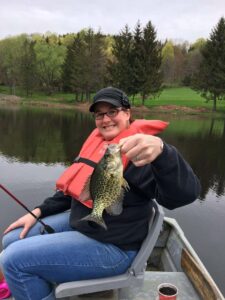
That message lives in every aspect of Sally’s life. Her hands create intricate patterns in the hats and scarves she donates to homeless shelters. She sews bright dresses that travel across the ocean to bring smiles to girls in Africa. She’s returned to the outdoors she loves, tending her garden, woodworking, boating, jetskiing, fishing and swimming without worry. She wears the pretty dresses that make her feel like herself and greets customers at work with genuine confidence.
The physical scars have faded, but the inner strength she discovered remains. “When I look in the mirror now, I see someone who chose to fight,” she says. “And I’m proud of who she became.”



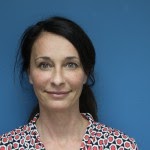 Hello, my name is Melanie Morreale. I attended art school in 1992, majoring in graphic art. Some of the things I loved were color theory, photography and illustration. I started my tattooing apprenticeship while in school and began working full time as an artistic tattoo artist right after college.