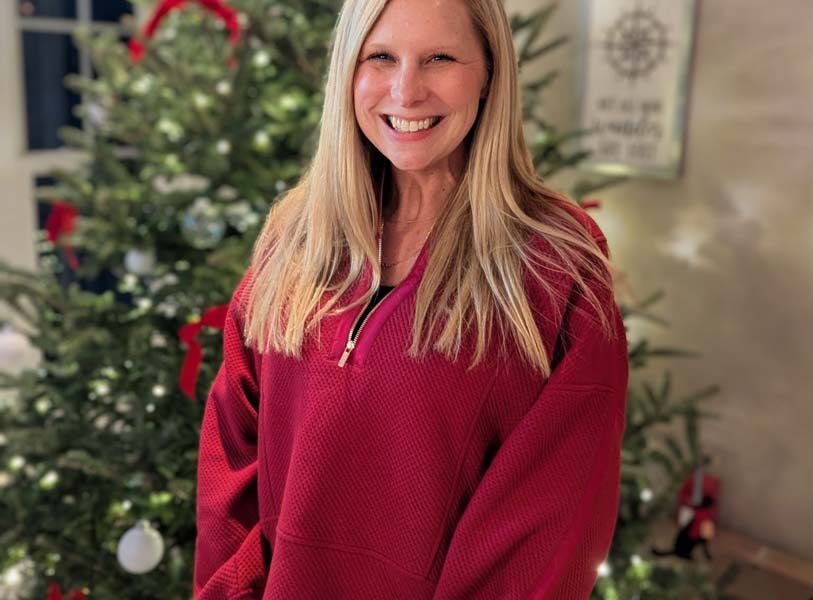
The night Lindsay Gruhn told her three children she had breast cancer, she gathered them in the family room of their Webster, New York, home and made them a promise she had no way of knowing she could keep.
“You guys, Mom has breast cancer. It’s going to be okay. We’re going to get through this.”
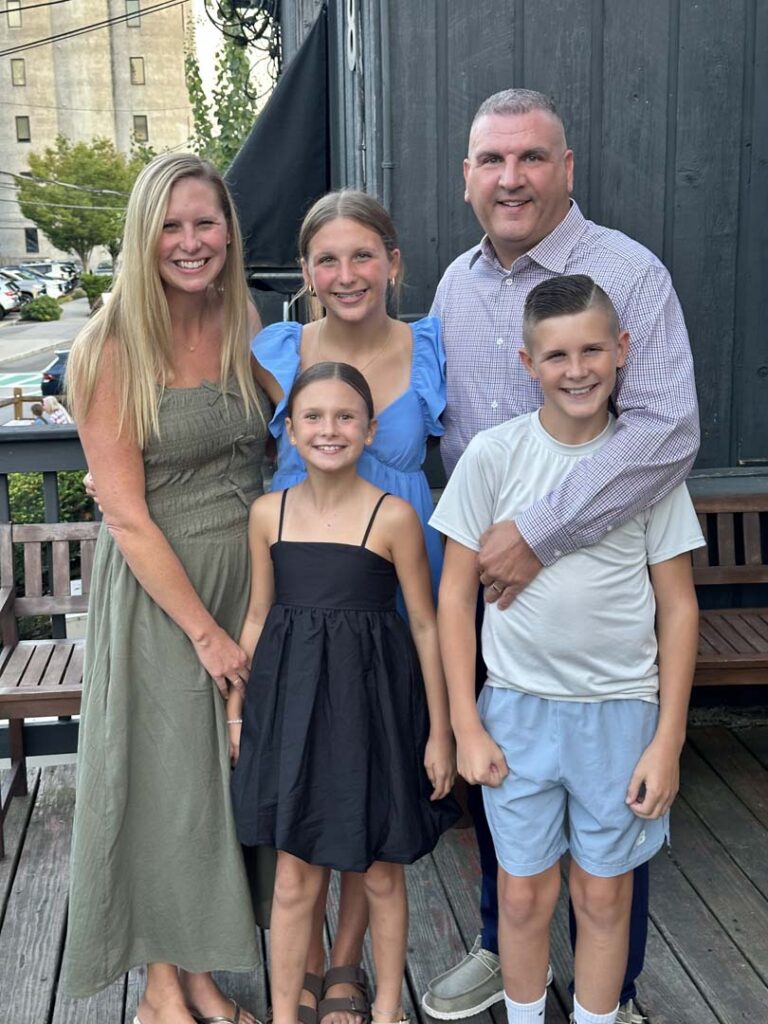
Avery, Henry and Reese looked back at her, and then the tears came. That night, all five of them slept together in the family room, a pile of blankets and pillows and held breath. In the weeks that followed, the kids would wander into their parents’ bedroom with sleeping bags, needing to be close.
Lindsay had said it would be okay. Now she had to make it true.
Always on the Go
To understand Lindsay, you have to picture her in motion. A nurse for more than 21 years, she spent over a decade in pediatric oncology and surgery before moving to the newborn nursery and NICU, following in the footsteps of her mother, who has worked in the same NICU for 46 years. At home, she and her husband, Chris, her high school sweetheart, were raising three athletes. Avery and Reese play travel lacrosse and soccer. Henry plays lacrosse and golf. Weekends meant fields in Philadelphia, New Jersey, Delaware, Canada… anywhere the tournament schedule sent them.
“We were always going somewhere,” Lindsay says. “Games, practices, tournaments five hours away. I loved it. That was our life, and I wouldn’t have traded it.”
Ask her to describe herself before her diagnosis and she lands on happy, outgoing and family-oriented. Optimistic to her core. The one who tells everyone it’s going to be okay.
Her family needed that optimism more than usual in 2023. The year before, Lindsay’s Uncle Dan, her father’s brother and closest friend, had passed away from pancreatic cancer. The loss shook their large, tight-knit family, the kind of family that fills a house with 75 people at Christmas. Lindsay spent that year doing what she does best: showing up, supporting her aunt and cousins, and holding everyone together.
She never imagined she’d be the next one who needed holding.
The Week Everything Changed
Lindsay had been diligent about her breast screenings, starting mammograms at 39. Her February visit to Elizabeth Wende Breast Care in Rochester had come back clear. So when she noticed some unusual nipple drainage that fall, cancer wasn’t her first thought, but her OB agreed she should get it checked out.
The Monday after Thanksgiving 2023, Lindsay went in for imaging. The mammogram turned into more pictures, then more, then an ultrasound. Dr. Posy Seifert at Elizabeth Wende wanted a biopsy. She estimated a 10 to 30 percent chance that it was anything serious.
The next afternoon, Lindsay was out shopping, trying to keep her mind busy, when the results hit her patient portal. She drove the 10 minutes home so she could open them with Chris. Even then, standing in her own kitchen with her husband beside her, she hesitated. Part of her wanted to wait, to hold onto a few more hours of not knowing.
“He kept saying, ‘Linds, it’s not cancer, just open it,'” she remembers. “He was so sure. And I opened it and saw grade 3 carcinoma, and everything just stopped. I said, ‘Oh my God, Chris, I have cancer.'”
Chris was shocked. “He said, ‘No, you don’t. That’s not what that says.’ And I had to look at him and tell him, yes, it is. That’s what those words mean.’ He kept asking, ‘Are you sure? Are you sure?’ He wanted to wait for the doctor to call and explain the results. He just couldn’t believe it was happening to me, to us. I think watching it hit him was almost as hard as reading the words myself.”
Her two decades of nursing meant there was no softening the language on that screen, no room to hope she was misreading it. But those same instincts sent her mind racing to darker questions. She’d spent years around childhood cancer, and seeing “grade 3” on her own results, her first terrified thought was whether that meant stage 3.
Once the shock loosened its grip on him, Chris found his footing the only place he knew to look: her. “He took a breath and said, ‘Okay. Okay. We’re going to figure this out. Don’t worry, Linds. We’ll figure it out.’ He didn’t have any more answers than I did. But he wasn’t going to let me stand in that kitchen feeling alone, and I never did. Not once, through any of it.”
The diagnosis was ductal carcinoma in situ, nuclear grade 3. Within the hour, two of her closest friends had appeared at the house, quietly taking the kids to soccer practice and wherever else they needed to be. Her dad came up. Her mom left her NICU shift and drove straight over.
Dr. Seifert called at 4:30 that afternoon and stayed on the phone as long as Lindsay needed, explaining everything with a patience Lindsay still marvels at. Even so, the shock ran deep. There was no breast cancer among her blood relatives. And her family was still grieving.
Six days later, Lindsay walked into a celebration of her Uncle Dan’s life, one year after his passing, and faced 22 cousins and a house full of aunts and uncles who had just learned her news. Every hug carried the same unspoken fear.
“Nobody was prepared for this to happen to our family again,” she says. “I could see it in their faces. And I remember thinking, I can’t let them be scared for me. I have to show them we’re going to be okay.”
A phrase was forming, the one that would carry her through the next two years. Not “I’ve got this.” Instead, it was “We got this,” because from the very first day, Lindsay understood this fight would also belong to all of them. Her husband, her kids, her parents, her army of cousins and friends and the doctors she hadn’t even met yet. She wasn’t asking anyone to save her. She was inviting them all in.
Strong for Them
December became a blur of appointments, and through it all, Lindsay made a decision that would define her recovery before it even began. Her kids were watching her. So was everyone else. Whatever fear she felt, she would deal with it on her own terms.
Sometimes that meant slipping away to the master bathroom at the far end of the house to cry where no one could see. Her oldest, Avery, was watching her mother like a hawk, convinced that any tears meant Lindsay was hiding something worse.
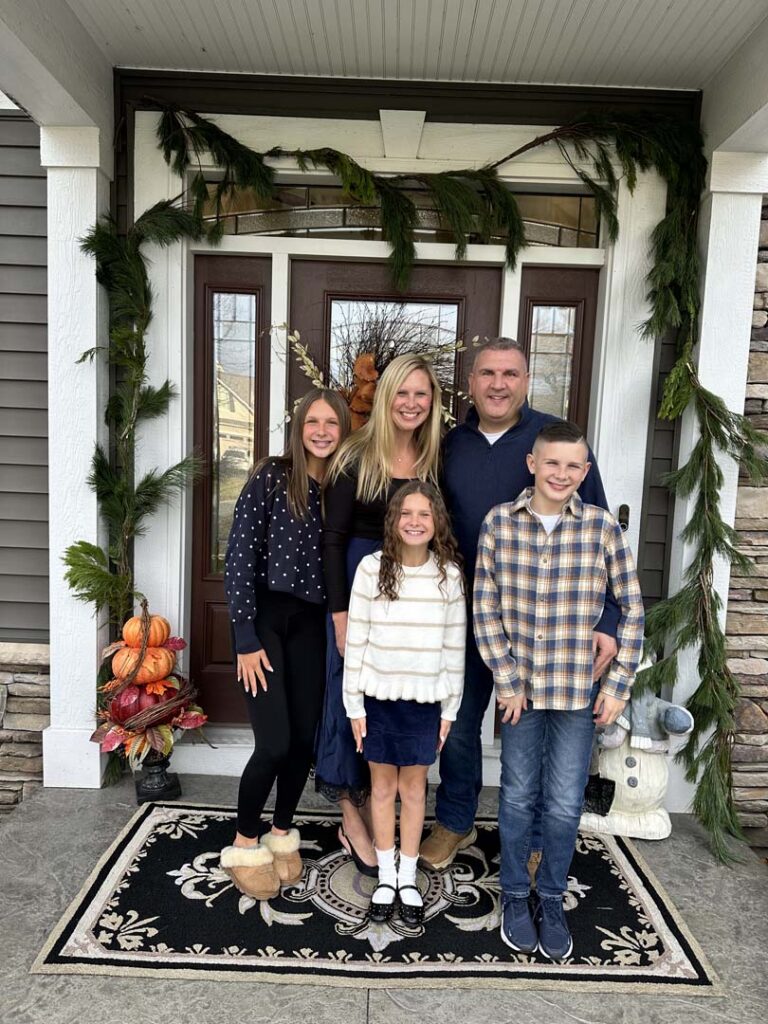
“If they saw me crying, they thought there was more I wasn’t telling them,” Lindsay says. “So I’d go cry alone, then wash my face and come back out. I had to be strong for them. I told myself that every single day.”
It wasn’t performance. It was protection, the same instinct that had her reassuring Henry, who couldn’t stop thinking about his great uncle, that this wouldn’t be like that. The same instinct that had her promising Reese, her youngest, that yes, mom was okay, every time the 7-year-old checked. Which was often.
Her faith steadied her in the hours no one saw. Chris worked nights, and Lindsay barely slept that December. “I’d wake up at two or three in the morning and just start praying. Hail Marys, the rosary, over and over. That’s what gave me peace.”
And she kept moving. Friends and teammates’ parents offered to drive the kids everywhere, and Lindsay gratefully accepted the help, but she refused to disappear from her own life. She still took her kids to practice. She made sure they saw Christmas lights. She kept every tradition she could.
“Everyone kept saying, ‘Lindsay, you’re doing it, you’re so strong,'” she recalls. “And I’d correct them. No. We’re doing this. All of us, together. That’s the only way I knew how to think about it.”
The Best Patient in the Building
If anyone understood what good care looks like, it was Lindsay. She’d spent 12 years in pediatric oncology, cheering on children through the hardest fights of their lives. Now, watching her own diagnosis unfold, she drew on their example.
“I kept thinking about my patients who were kids with cancer, how brave they were,” she says. “I was their cheerleader for all those years. Now it was my turn, and I thought, if they can do it, I can do it.”
She also made a professional choice about the kind of patient she’d be. “I know how patients can be. I decided to be the best patient I could be. Go in with a positive attitude, listen, trust the people taking care of me and let them do what they do.”
Choosing those people turned out to be the easiest decision of the whole experience. When Dr. Seifert recommended breast surgeon Dr. Rachel Farkas and plastic surgeon Dr. Stephen Vega, Lindsay asked whether she should look around, get other opinions. Dr. Seifert’s answer settled it: if the roles were reversed and Lindsay named a pediatric surgeon she trusted, that recommendation would be enough.
“That was all I needed to hear,” Lindsay says. “I never once thought about anyone else.”
What she found at Vega Plastic Surgery confirmed it. The office was calm and quiet, nothing like the loud, crowded waiting rooms she expected. The front desk staff was warm on the phone before she’d ever walked through the door, reassuring her she’d be seen right away. And Dr. Farkas gave her something Lindsay, as a nurse, knew was rare: time.
“She sat right next to me and Chris, drew pictures, showed us everything, explained every option and why,” Lindsay says. “She talked to me like a friend. We could go from surgical plans to the kids’ lacrosse schedules in the same conversation. I walked out of that appointment knowing these were my people.”
Behind the scenes, that team was already working for her. Dr. Seifert had called Dr. Farkas at 8 a.m. on a Saturday to discuss her case. “I’ve never had doctors do that in my life, and I’ve been in healthcare for over 20 years,” Lindsay says. “They treated me like I was the only patient they had.”
Dr. Farkas recommended a double mastectomy, walking Lindsay through every alternative and the reasoning behind each one. Lindsay agreed without hesitation. The plan came together quickly: Dr. Farkas would perform the mastectomy, and Dr. Vega would place tissue expanders in the same surgery, the first stage of implant reconstruction, so Lindsay wouldn’t need to come back for a separate expander operation. Dr. Farkas checked the calendar herself and coordinated the schedules so the two surgeons could be in the operating room together.
For Lindsay, reconstruction was never in question. “I knew I wanted to feel like myself again. I wanted to look in the mirror and see me.”
January 5, 2024
On the morning of her surgery, Dr. Farkas came into the pre-op area wearing her surgical cap and greeted Lindsay with three words: “We got this.”
“She said my phrase back to me,” Lindsay says, still touched by it. “And it reassured me that I was exactly where I was supposed to be.”
The surgery took five and a half hours. When it was over, Dr. Farkas went straight to the waiting room to find Lindsay’s parents and Chris, walking them through how everything went and taking a moment to make sure Mama Carol, as the team came to call Lindsay’s mother, was holding up okay too. The early news was hopeful.
The first voice Lindsay remembers hearing in recovery was Dr. Vega’s, calling down the hallway: “Is that my patient awake down there?”
Nine days later, on a Sunday morning while the family was getting ready for church, Lindsay’s phone rang. It was Dr. Farkas, calling from home with the pathology results. All of the cancer had stayed contained in the removed ducts. The lymph nodes were clear. Lindsay would not need chemotherapy.
“She called me from her own bed on a Sunday because she didn’t want me to wait one more day for good news,” Lindsay says. “And then she told me, ‘Tell Mama Carol we got it!’ I’ll never forget that as long as I live.”
The promise Lindsay had made her children in the family room was becoming true.
The Long Middle
What most people don’t see with breast reconstruction is the middle part, the months between the big milestones. Lindsay lived it with the same determination she’d brought to everything else.
Recovery from the mastectomy meant weeks of limited arm movement while her body healed, and simple things like washing her hair took patience and help. She started physical therapy to rebuild her strength and range of motion, and by April, she was back at work in the NICU, reaching for her tiny patients again.
Every few weeks, she returned to the office, where Danielle, PA-C, and Christina, FNP-C, gradually filled her tissue expanders, stretching the skin a little at a time to prepare for her implants. She won’t pretend the expanders were comfortable. “They felt like Tupperware containers,” she laughs. “But every appointment meant progress. The cancer was gone, and I was getting closer to being me again. I looked forward to those visits.”
She found ways through the uncomfortable stretches, sleeping propped up on the couch for a while, wearing the surgical bras, giving her body the time it asked for. “It was humbling,” she admits. “I’m a go-go-go person, and healing doesn’t care about your schedule. I had to learn patience with myself.”
Through it all, Dr. Vega’s attention never felt routine. He shook Chris’s hand at every appointment and made sure he understood everything too. “They always recognized that this happened to our whole family, not just to me,” Lindsay says.
At one preoperative visit, Dr. Vega stopped and looked at her. “He said, ‘You’re always so smiley and happy. But how do you really feel?’ And I just burst into tears. Happy tears, mostly. Relief. He wanted the real answer, not the brave face. What doctor really checks in like that with their patients?”
On July 23, 2024, three days before her 16th wedding anniversary, Lindsay had her exchange surgery. Dr. Vega removed the expanders, placed her implants and used fat grafting to give the results a soft, natural contour.
“I woke up and touched them and thought, oh my gosh, they’re round, they feel normal,” she remembers. “When the bandages came off, I was so relieved. They looked like me. Dr. Vega did such a beautiful job.”
Several months later, when some of the grafted fat cushioning her left implant thinned out, leaving that side irritated and tender, Dr. Vega listened, monitored it and resolved it with an additional round of fat grafting, a quick procedure with an easy recovery. “He told me he’s there for anything I need, anytime,” Lindsay says. “And he means it. That’s not something you get everywhere.”
The Finishing Touch
The final piece came in May 2025, when Lindsay had 3D nipple tattoos done right in Dr. Vega’s office by the practice’s visiting tattoo artist. Dr. Farkas and Dr. Vega had encouraged her to consider it, and she’s glad she listened.
“I don’t have any other tattoos, so I was nervous,” she says. “But it was so easy, and they look so real. That was the moment I looked in the mirror and felt completely whole again.”
The convenience meant as much as the artistry. “Everything I needed was right there in one place. When you’re already going through something stressful, they make every single step simple and comfortable. You never feel like you’re being sent off to figure something out alone.”
At her appointment, the staff handed her a small gift: a certificate for a complimentary facial, as a congratulations for completing her reconstruction. It was one more example of something Lindsay noticed the whole way through. “When I’d call, they’d answer, ‘Hi, friend!’ Like we’re close friends or even family. Every person in that office, from the front desk to the doctors, made me feel like I mattered.”
In the fall of 2025, Lindsay finished her last session of physical therapy. Her follow-ups with Dr. Farkas and Dr. Vega have all come back perfect. She’s officially done with her reconstruction, cleared until her routine annual visits.
A Promise Kept and a Grateful Heart
Two years to the week after the imaging appointment that set everything in motion, Lindsay marked the milestone the way she does most things, surrounded by people, at a Christmas party with the friends who had sat on her couch, brought food and comfy clothes and shown up again and again. The date that once split her life in two had become yet another reason to celebrate.
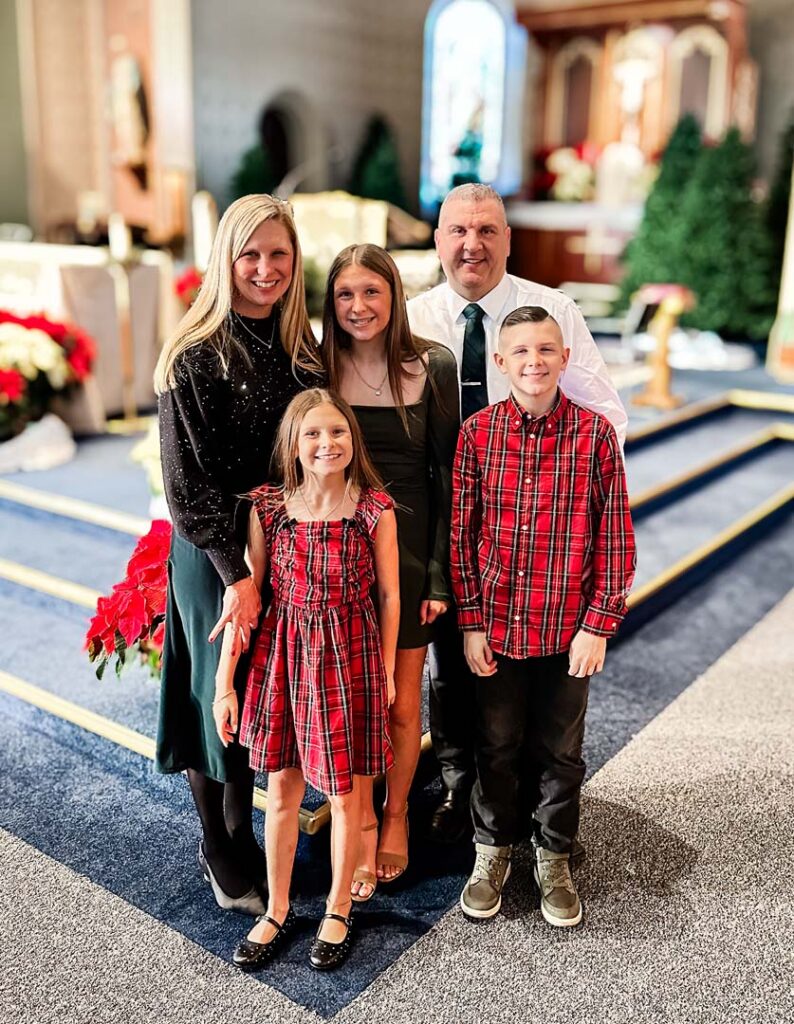
Ask her to describe herself now and the words have changed. Stronger. Grateful. Aware of what matters.
“I’ve always been thankful for what I have, but it’s different now,” she reflects. “I look at my family and I think, this is it. This is what’s important. We do more together now. We listen to each other more. We don’t sweat the small stuff.”
She’s also settled into a new outpatient nursing position with more regular hours, a change her family encouraged so she could be home more evenings and miss fewer games. She misses her NICU babies and the coworkers who became family over the years, but she carries what they taught her into every patient interaction. And her experience on the other side of care has deepened the way she practices.
“I’m more patient now. I want to hear people’s stories. I want every patient to know I’m truly listening and that I care, because I know now, in a way I didn’t before, how much that matters when you’re the one in the bed.”
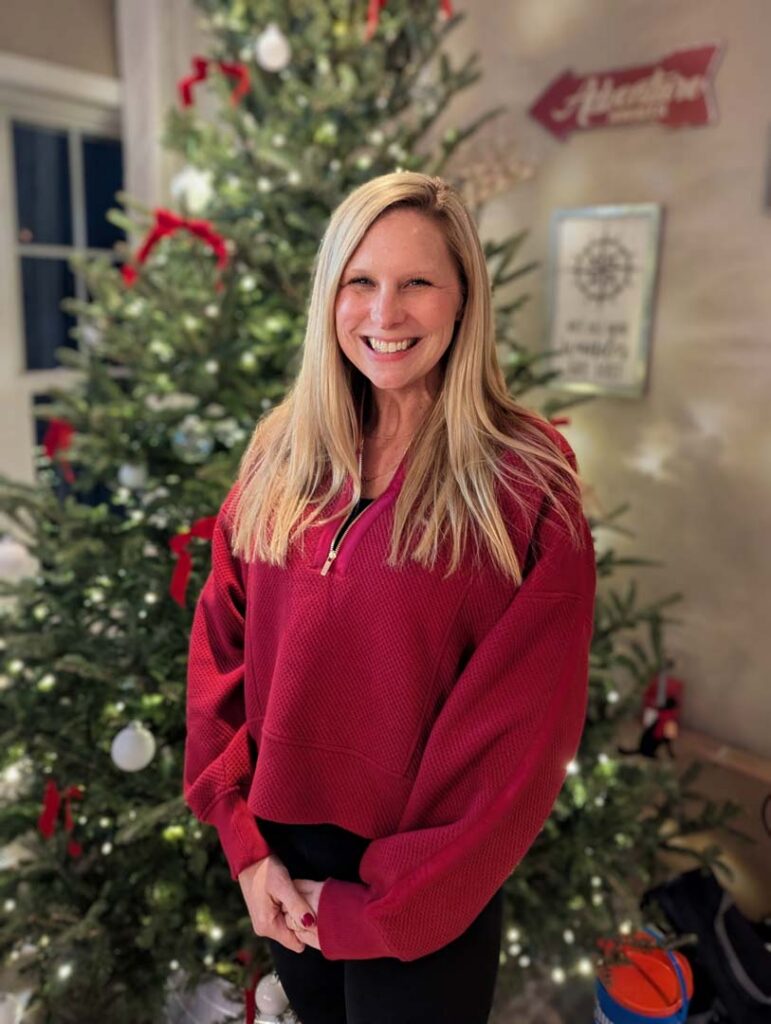
Her scars have healed. Her implants feel like part of her. The summer after her reconstruction was complete, she wore a bathing suit at Ocean City between her daughters’ lacrosse tournaments and again at Anna Maria Island with friends, comfortable and confident. “I feel whole,” she says simply. “I feel like me.”
Her Advice, From Someone Who Kept Her Word
To anyone newly diagnosed or facing decisions about mastectomy and reconstruction, Lindsay’s message comes straight from experience.
“You can do this. Stay as positive as you can, lean on the love around you and know that even on the hard days, you will come out the other side and be you again. It’s not fair, and some of it is really hard. But you’ve got this.”
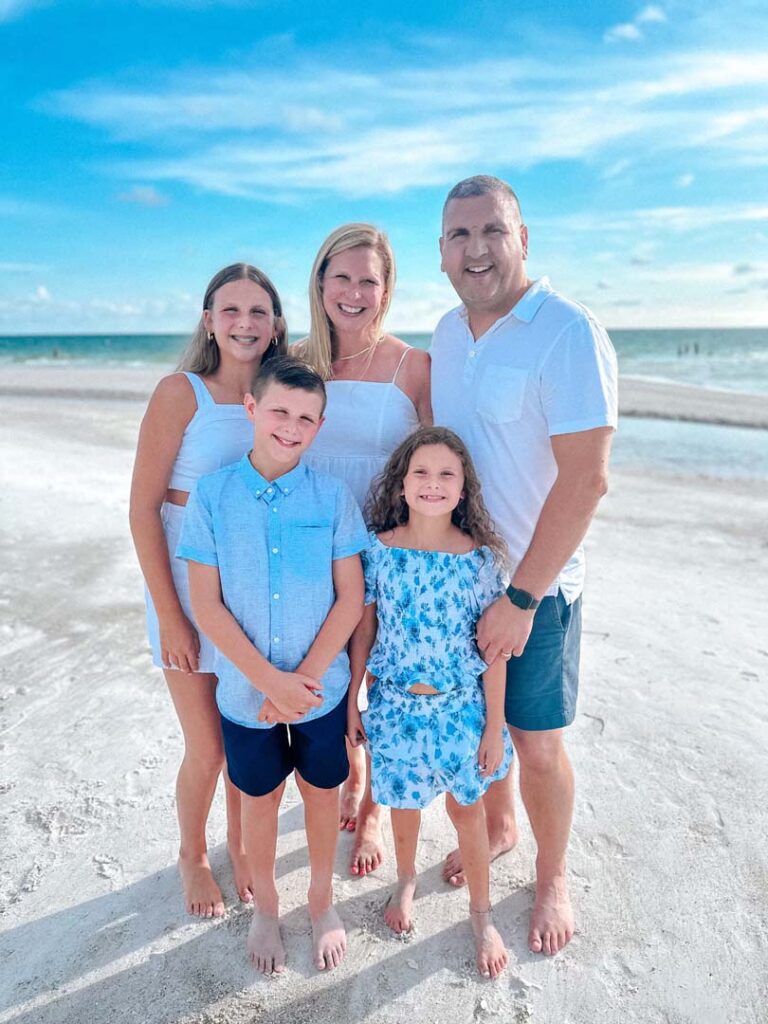
And when it comes to choosing a surgical team, she doesn’t hesitate. “Dr. Farkas and Dr. Vega made sure I was okay every step of the way. They sat at my bedside before and after surgery. They answered every question. They talked to me about my kids and my life like friends do. I could not have gotten through this without them, and I would tell anybody and everybody to go to them. You will get the best care there is.”
At an appointment near the end of it all, Dr. Farkas gave Lindsay one final piece of medical advice, delivered with her signature spark: “I better see you in a bikini. Be proud. Show them off.”
Lindsay laughs telling it. But underneath the joke is the truth of what was rebuilt over those two years, along with something no surgery could create. A promise made to three scared kids in a family room, kept in full.
Mom had breast cancer. And she was right. It was going to be okay.